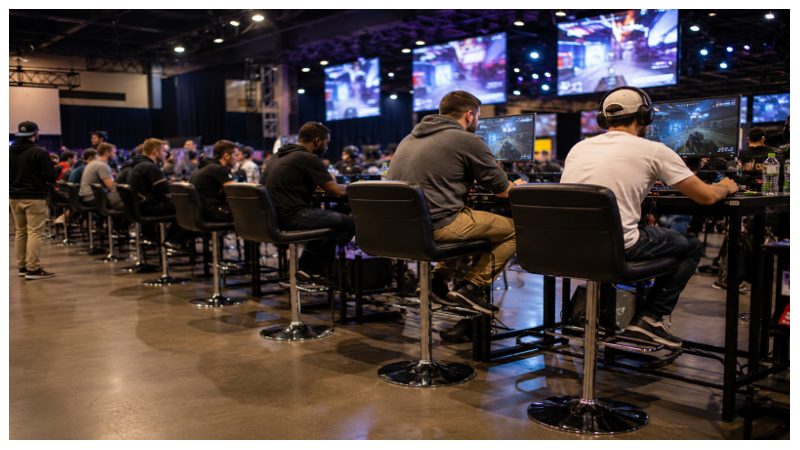
Picture the same room at four points in one day. At eight in the morning it is registration, with everybody standing. By eleven it is a competition floor with people seated for hours at a stretch. At six it is a viewing area where nobody sits at all, and by nine it is a bar. Four rooms, one floor, one set of furniture.
That is the condition tournament venues live in, and it is why their requirements for bar stools look nothing like a restaurant’s. A restaurant stool has one job in one configuration. A tournament stool has to be moved four times, sat in for six hours, stacked overnight and put back tomorrow, and the specification that survives that is a different specification entirely.
The Duty Cycle Is the Whole Problem
A bar stool in a bar is occupied intermittently. Somebody sits, drinks, leaves, and the seat gets an hour of rest between occupants.
At a tournament the same stool holds one person continuously from the start of a round to the end of it. Competitive events run long, and the participant does not get up because leaving means forfeiting position. That is a load case ordinary hospitality never produces, and it exposes every shortcut in a seat pan within the first event.
The failure is rarely structural. It is that the seat becomes unbearable at hour three and the venue gets feedback about the event rather than about the furniture.
What Long Occupancy Actually Requires
Three dimensions matter more than everything else combined.
A footrest that carries real weight, positioned around ten inches below the seat, because at three hours the legs are doing the work the floor would normally do. A seat with a front edge that curves away rather than terminating in a line, since the same edge that is tolerable for twenty minutes cuts off circulation at two hours. And a back, even a low one, because unsupported sitting past the ninety-minute mark is a posture problem rather than a comfort preference.
Venues that specify all three report a different quality of complaint at the end of a long day. Venues that specify none get told the event was gruelling and never learn why. Nobody writes in to say the stool was bad. They say they wouldn’t do it again.
Reconfiguration Is a Labor Cost, Not an Inconvenience
The second requirement is about the four transitions rather than the six hours.
A stool that cannot be stacked takes up valuable floor space and creates unnecessary storage demands. Heavier models can also slow down setup because moving a twenty-pound stool requires a two-handed carry, limiting how many a crew member can transport at once. Fixed, wide bases create another challenge: instead of nesting neatly, dozens of stools can quickly turn into a bulky wall of furniture.
Professional bodies for venue managers have been pushing members toward measuring changeover time as an operating metric rather than treating it as an unavoidable overhead. Once it is measured, seating weight and stacking behavior stop looking like details.
The Occupant Load Question Changes With the Configuration
There is a compliance dimension that gets missed precisely because the room keeps changing.
Occupant load and egress calculations under the Life Safety Code depend on how a space is being used and how it is furnished. A room that is standing-room at six and seated at eleven has two different answers. Venues that calculate once, for the configuration on the drawing, are not covered for the configuration they actually run.
Stool count interacts with this directly. Adding twenty seats to a viewing area because participants asked for them is a change to the occupant load assumption, not a hospitality gesture.
Where the Market Is Heading
It is worth being concrete about scale, because this is not a niche.
The Events Industry Council’s economic significance study with Oxford Economics put global business events participation above 1.6 billion people, with direct spending measured in the trillions. Venues competing for that volume are increasingly competing on flexibility rather than on square footage, and flexibility is a furniture property.
The venues taking share are the ones that can run four configurations in a day without a crew of twelve. That is a purchasing decision made years earlier, and it is usually made without anybody framing it that way.
What a Tournament Specification Looks Like
For a venue writing a stool specification with multi-configuration days in mind:
- Stackable to at least six high, with a stated stacked height in inches
- Under fifteen pounds, so one person carries two
- Footrest at ten to twelve inches below the seat, rated for full weight
- Waterfall or dished seat front, never a square hard edge
- Low back available as an option on part of the order
- Soft glides, because a competition floor cannot tolerate scrape
The Argument for Buying Two Heights
One decision separates venues that cope from venues that improvise.
Buying a single stool height locks the room into a single counter relationship. Buying two, typically a counter height around twenty-five inches and a bar height around thirty, means the same inventory serves a seated competition floor and a standing bar without renting anything.
The cost difference at order time is close to nothing, since it is the same product line. The difference over five years of events is a rental line that never appears.
Where the Next Tournament Room Will Differ
Anticipate what these rooms look like once venues start specifying for the day rather than for the photograph.
The furniture will be lighter, it will stack higher, and it will come in two heights as a matter of course. Seats will have backs on a proportion of the order rather than as an exception. And the changeover between configurations will be a twenty-minute job for three people instead of an hour for eight.
None of that requires new technology or a larger budget. It requires the buyer to specify against the hardest hour of the longest day rather than against the room as it appears in the brochure. That hour is when the seating either holds up or quietly becomes the thing everybody remembers about the event.